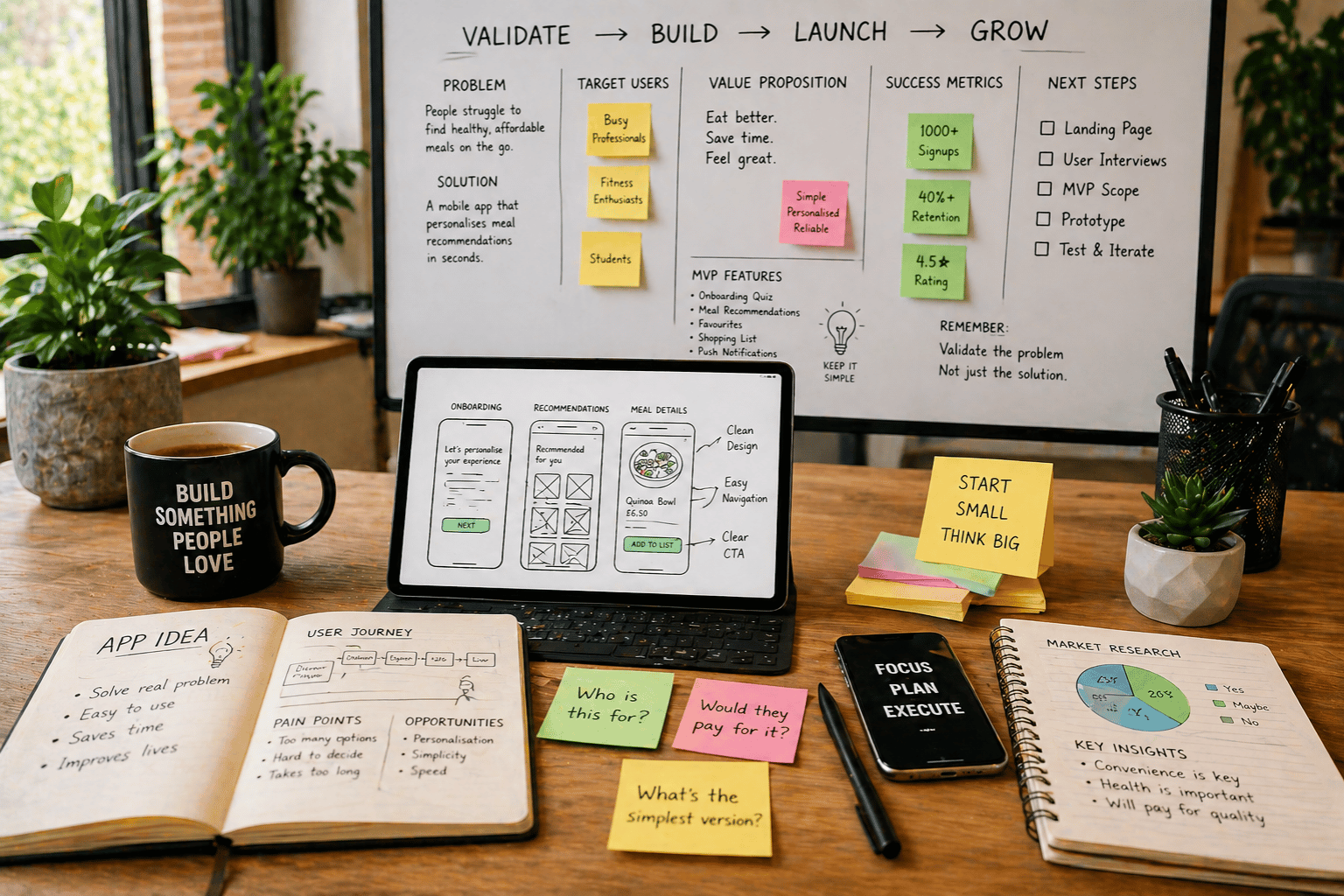
Building an AI product is easier than ever
Everyone has an AI idea right now.
“I want to build an AI app.”
“I’ve got a ChatGPT-style concept.”
“This will disrupt the industry.”
Most of them skip one crucial step – what should you actually build first? We see this regularly when we meet clients looking for Startup MVP Development services. Founders jump straight into complex builds, burn through budget, and realise too late that they built TOO MUCH too early. But we can fix that.
What an MVP actually means
MVP doesn’t mean:
- A half-built app
- A buggy prototype
- Something “cheap and rushed”
A proper MVP means “The simplest version of your idea that proves people will use it” and that’s literally it. Especially with AI, your MVP should answer:
- Do people actually want this?
- Will they use it more than once?
- Does it solve a real problem?
- Will they pay for it (eventually)?
If your MVP can’t answer those, you don’t have a product yet.
The biggest mistakes founders make
They try to build the full platform straight away before they’ve proven anyone cares. Think:
- Full mobile app
- Complex backend
- User dashboards
- Payment systems
- Multiple AI features
- Polished UI
This is how budgets disappear and why most AI startup ideas never make it past version one.
What you should build first instead
Let’s simplify it. Here’s what a smart AI MVP actually looks like in 2026:
1. One Core Problem. One Core Feature.
Not five features. Not a full product suite. One problem → one solution. Examples look something like this:
- AI that generates meal plans weight loss target
- AI that summarises meeting notes
- AI that suggests running routes
- AI that rewrites product descriptions
Pick one use case and nail it. Everything else comes later.
2. A Simple Interface (Not a Full App)
You do NOT need a full mobile app to start. In most cases, your MVP should be:
- A simple web/mobile app
- A landing page + input/output tool
- A lightweight dashboard
- Even a guided form with AI output
Why? Because speed matters more than polish. This aligns perfectly with how smart startup builds should work — validate first, scale later.
3. AI Integration That Actually Works (Not Just Sounds Cool)
AI is the tool, not the product. This is where a lot of founders go wrong. Ask yourself what it actually does for the user, rather than just using AI for the sake of saying you use it. Your MVP should clearly demonstrate:
- What the AI does
- How it helps
- Why it’s better than doing it manually
If it’s not obvious within seconds, it’s not ready.
4. Real User Testing (Early and Often)
Your MVP is not complete when it’s built. It’s complete when real people use it. That means:
- Getting feedback early
- Watching how users interact
- Identifying friction points
- Improving quickly
No guesswork. No assumptions. Just real data.
5. A Clear Path to Monetisation
You don’t need to charge on day one. But you do need to know how it’s going to make money. You’re validating the concept. If downloads and retention are flying, this bodes well for future monetisation trials. Options might include:
- Subscription model
- Pay-per-use
- Premium features
- Business licensing
If there’s no clear path to revenue… you’re building an expensive project, not a business.
Real example: Good vs bad MVP thinking
Bad Approach:
“Let’s build a full AI fitness app with tracking, dashboards, social features, workout generation and subscriptions.”
Smart Approach:
“Let’s build a tool that generates a personalised workout that specifically targets a simple pain point prompt, in 10 seconds.” Think of an aspiring track athlete who needs to improve bursts of speed. A surfer looking to improve core stability. A golfer wanted to improve lower body flexibility. They type a short prompt explaining their problem, the app creates a workout to resolve it.
Test that. If people love it → expand.
If they don’t → pivot early.
Guess what, we’ll even build it for you. Check out our Startup MVP Development services.
This smart approach works because you’re not guessing – you’re learning. More importantly, you’re not over building. Most startup costs come from unnecessary features. Things nobody asked for. Things nobody uses. Things that sounded good in a planning session. A focused MVP avoids all of that.
Where most AI MVP’s go wrong
Let’s be brutally honest, most fail because:
- Too many features too early
- No real user validation
- Overcomplicated builds
- No clear problem being solved
- No monetisation thinking
- Built for investors, not users
- And the big one – Trying to look like a finished product instead of proving demand
Your MVP is not your final product. It’s your test.
The Develoroo approach to MVP development
We keep it simple because simple works:
- Start with your business goal
- Strip the idea back to its core
- Build only what’s needed to validate
- Test it with real users
- Improve based on feedback
- Then scale properly
No over-engineering. No fluff. No “let’s just add this feature as well.” This matches exactly how your site is structured to guide startup founders through the process and into real decisions — not just theory .
Final thought: Build less. Learn faster.
The biggest advantage you have in 2026 isn’t AI. It’s speed. The faster you learn what works, the faster you can build something people actually want. So instead of asking:
“How do I build my AI app?”
Ask:
“What’s the smallest version of this idea that proves it works?”
That’s your MVP – your minimum viable product.
If you’ve got an idea but aren’t sure what to build first, we’ll help you figure it out properly. No jargon. No overcomplicated plans. Just clear direction and a build strategy that actually makes sense.
Startup MVP Development Services 📈