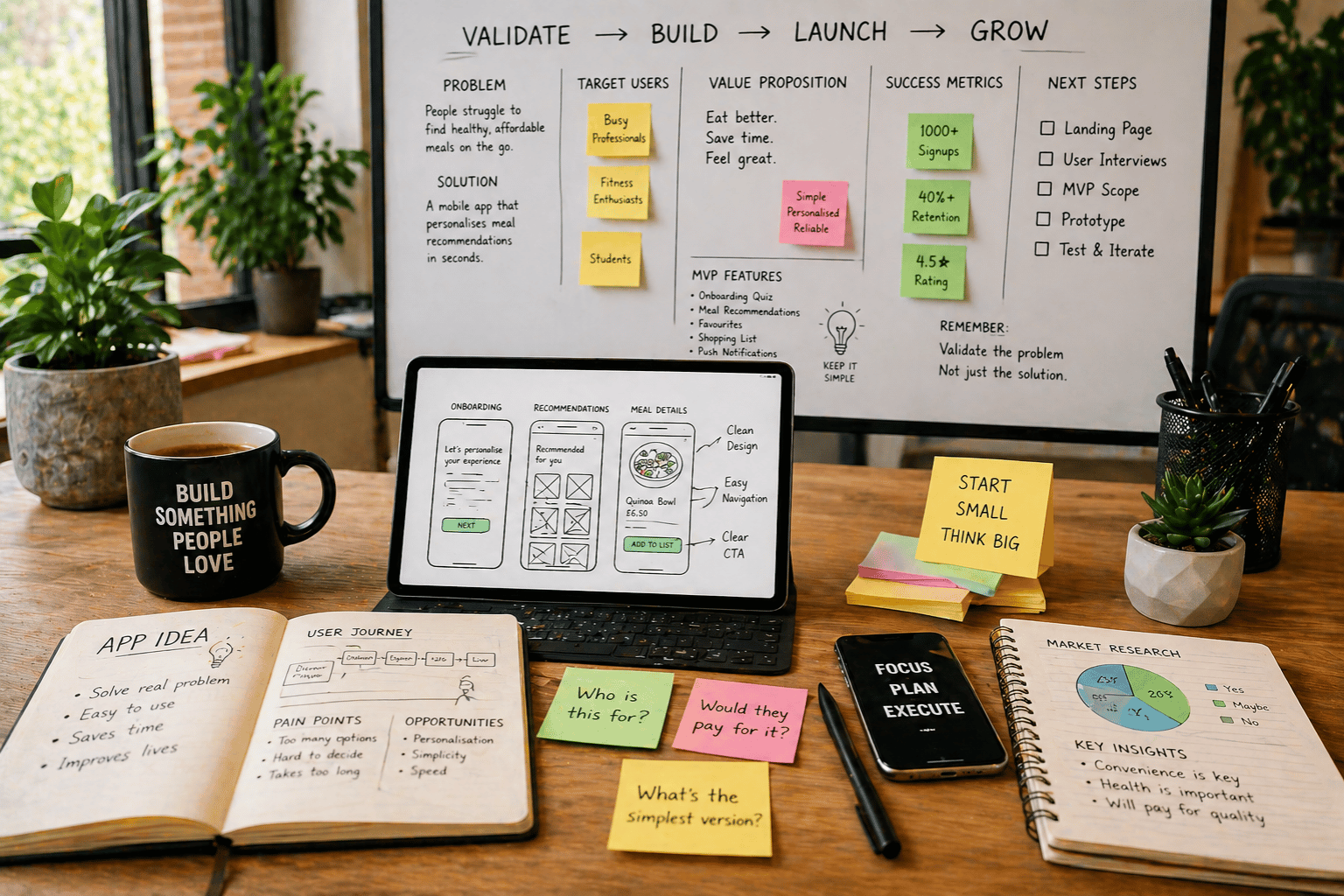
App validation, what’s it all about?
Many startups make the same expensive mistake. They spend months building an app… only to discover that nobody actually wants it. Building software is time-consuming and costly. Even a relatively simple mobile app can require thousands of pounds in development time, planning, and testing.
Validation simply means proving that a real market exists for your idea before investing heavily in building it. Check our our Mobile App Development or Startup MVP Development service pages for more info on how we can build for you 🫵🏼 . Otherwise, read on.
Step 1: Define the Problem Clearly
Every successful startup begins with a real problem. The biggest red flag is when founders start with:
“I’ve got a great app idea.”
Instead, the starting point should be:
“There’s a real problem people are struggling with that i think we can solve.”
Ask yourself:
- What problem does the app solve?
- Who specifically experiences this problem?
- How are people solving it today?
If the problem isn’t clear, the product won’t be either. The strongest startup ideas usually come from problems founders experience personally or repeatedly observe in a specific industry.
Step 2: Talk to Potential Users
This step is where many founders feel uncomfortable, but it’s also the most valuable. Speak directly to people who would realistically use your app. Ask questions like:
- How do you currently solve this problem?
- What frustrates you about existing solutions?
- Would you pay for something better?
You don’t need hundreds of interviews. Even 10–20 conversations can reveal huge insights. Often, these conversations will completely reshape the original idea. That’s a good thing. It’s easier than ever to gauge feedback on ideas nowadays, given the growth of social media as a research tool.
Step 3: Research the Competition
Competition isn’t a bad sign. In fact, it usually confirms that a market already exists. Look for:
- Similar apps
- Websites solving the same problem
- Businesses offering manual versions of the service
Use their products! Then ask yourself:
- What do they do well?
- What do users complain about?
- Where is the gap in the market?
Your goal isn’t necessarily to invent something completely new. Many successful startups simply improve an existing solution – DO IT BETTER! You may download a competitors app and not even make it beyond a long, painful draw out onboarding process.
Step 4: Test Demand Before Building
Before writing a single line of code, you can test demand using simple tools. For example, create a simple webpage explaining:
- the problem
- your proposed solution
- how the app will work
Some founders use a sign-up form, waitlist or offer pre orders for early access. If people sign up, that’s a strong signal of interest. This approach allows you to measure:
- how many people are interested
- who your early users are
- how excited they are about the product
If people are willing to pay before the product exists, that’s one of the strongest validation signals possible. If nobody joins the waitlist, that’s also pretty useful information to have…
Step 5: Build an MVP, Not the Full Product
Once demand is validated, the next step isn’t building the full product. Instead, startups build an MVP (Minimum Viable Product). An MVP focuses only on the core functionality needed to solve the main problem. Generally, they avoid:
- unnecessary features
- complex systems
- expensive development early on
The goal is to get something usable into the hands of real users quickly.
From there, you improve the product based on feedback. The good news is we can build that for you – check out our Startup MVP Development service page for more info or Get In Touch if you’ve got an idea to launch.
Step 6: Measure Real User Behaviour
The final stage of validation happens after the MVP launches. Key questions include:
- Are people actually using the product?
- Do they come back repeatedly?
- Are they willing to pay for it?
Real user behaviour is far more valuable than opinions. If users engage consistently, you know you’re building something valuable. If they don’t, the product can still evolve before too much money is invested.
The cost of skipping validation
Building an app without validating the idea is one of the biggest reasons startups fail. Common outcomes include:
- spending tens of thousands building something nobody needs
- discovering the real problem is different
- realising users won’t pay for the solution
Validation dramatically reduces this risk. It ensures development effort is focused on something that actually has demand.
Final thoughts
A strong startup idea isn’t just about creativity. It’s about solving a real problem for real people. By validating the idea first — through research, conversations, and simple testing — founders dramatically improve their chances of building something successful. Only once demand is clear should development begin. At that point, building an MVP becomes a strategic step forward rather than a risky gamble.
Startup MVP Development Services 📈