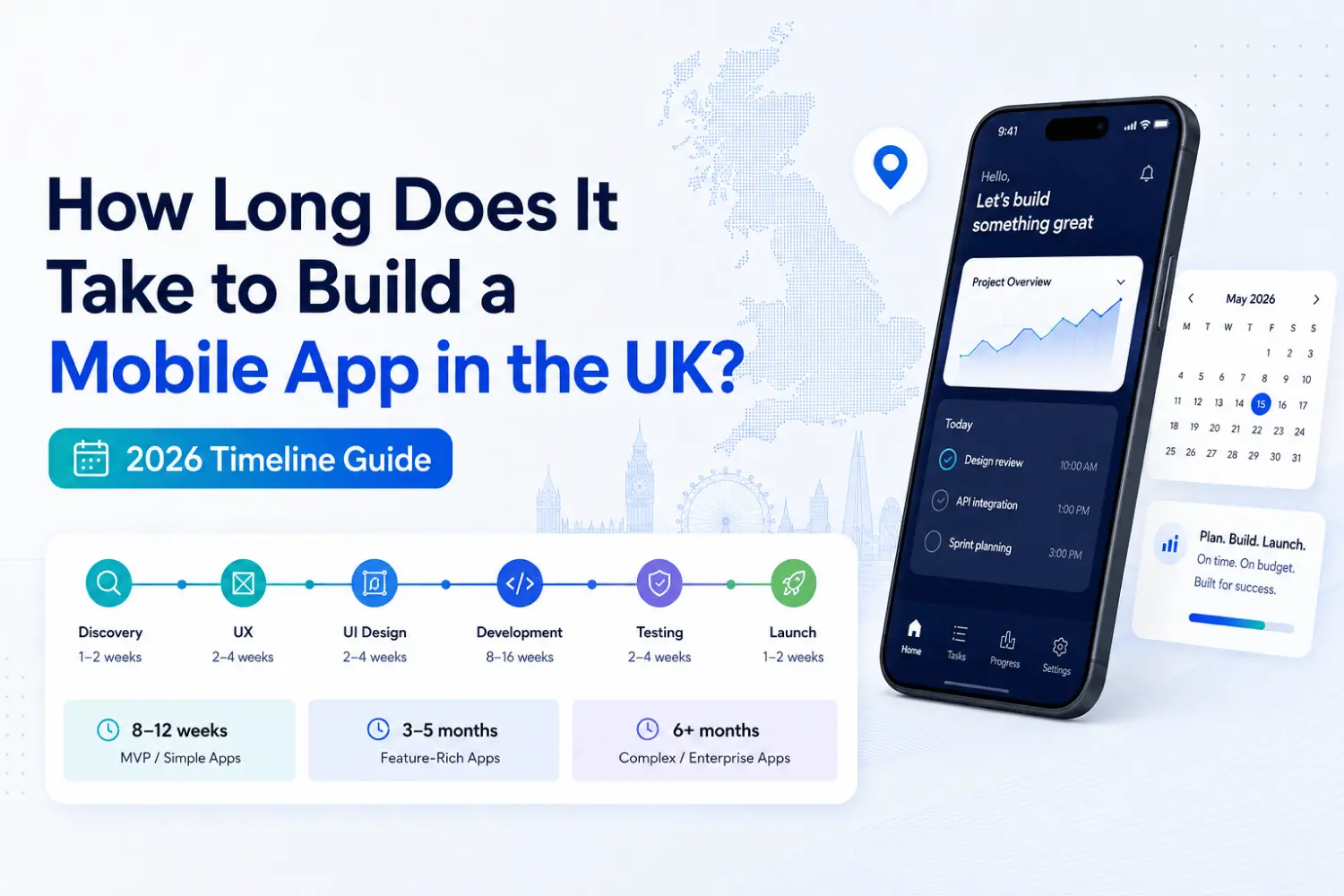
So, how long does it take to build mobile apps?
If someone tells you they can build your mobile app in two weeks, one of three things is probably happening. They’re building something extremely simple. They’re building a copycat app. Or they’re promising a timeline they probably shouldn’t be promising.
Proper mobile app development takes time to plan, design, build, test and launch. But that doesn’t mean every app needs six months and a six-figure budget either. For most UK businesses, a realistic mobile app development timeline sits somewhere between 8 weeks and 6 months, depending on what you’re actually building. The important bit is understanding what affects that timeline.
As a rough guide:
Simple mobile app: 8–12 weeks
Medium-complexity app: 3–5 months
Complex mobile app: 5–9+ months
Focused MVP: potentially 6–12 weeks
That sounds like a big range because “mobile app” can mean almost anything.
A straightforward booking app with user accounts and a few core screens is a completely different project from an app containing:
- live messaging
- maps
- payment processing
- subscriptions
- complex dashboards
- third-party integrations
- real-time data
- admin systems
- custom backend infrastructure
The more moving parts involved, the longer the project takes.
The right question isn’t “How quickly can an app be built?”. It’s more “How quickly can this app be built properly?”. Naturally, all of the above also influence how much it costs to build a mobile app.
Typical mobile app development stages
A mobile app project normally moves through several distinct stages. Skipping one of them might make the project look faster initially. It usually makes the problems appear later.
1. Discovery and project planning
Before any code gets written, the project needs to make sense That means understanding:
- who will use the app
- what problem it solves
- what the key features are
- what users need to accomplish
- whether iOS, Android or both are required
- whether an MVP would make more sense initially
- what third-party services will be needed
- what success looks like after launch
At this stage you can question any unnecessary features. Quite often stripping the first version back to the features users genuinely need, rather than building the “nice-to-haves”, results in a much better product and quicker launch.
2. Plan the UX and wireframing
Once the function you want to achieve from your app are clear, the app needs some structure. Wireframes map out things like”
- screens
- navigation
- user journeys
- actions
- forms
- menus
- account areas
- onboarding
- key conversion points
This stage prevents developers from effectively designing the app whilst they build it. That approach usually creates inconsistency, wasted development time and plenty of back-and-forth. Good planning makes development smoother.
3. UI design
Now the wireframes come to life. We build the visual interface of the app, this includes:
- colours
- typography
- buttons
- cards
- spacing
- navigation
- icons
- form states
- mobile layouts
- interaction patterns
We don’t want to make every screen look clever whilst utilising the most complex animation features of every UI design library going. The goal is simply to make the app look smooth, on brand, and easy to understand and use.
4. Mobile app development
This is where the actual application gets built. The exact development timeline depends heavily on functionality. A relatively straightforward business app might include user profiles, forms, notifications and content. A more advances app might include payments, recurring subs, GPS, live chat, complex searches or external API use.
Every additional system needs to be built, connected and tested. That’s why estimating app development purely by the number of screens is misleading. Two apps could both contain 15 screens while requiring completely different amounts of development work.
What about the backend?
Not every feature lives in the app itself. Most serious mobile applications need some form of backend infrastructure handling things such as:
- user accounts
- databases
- authentication
- content
- permissions
- notifications
- payments
- analytics
- administration
- cloud functions
- third-party integrations
In some projects, the backend requires nearly as much work as the visible mobile application. Users might never see it – but they’ll definitely notice if it doesn’t work.
5. Testing testing, 1 2 3
Testing shouldn’t start the day before launch. It should happen throughout the build. Before release, however, the complete application needs to be checked across real-world scenarios, on real devices, with real users. That includes features such as:
- navigation
- forms
- account creation
- login/logout
- permissions
- notifications
- different screen sizes
- loading states
- poor network conditions
- incorrect user input
- edge cases
- iOS behaviour
- Android behaviour
6. App Store and Google Play submission
The big one (well, they’re all big). Once the app itself is ready, it still needs to reach these stores to have a place to live. That normally means preparing:
- app descriptions
- screenshots
- icons
- privacy information
- age ratings
- permissions
- store listings
- developer account information
Apple and/or Google then review the app. Approval isn’t always immediate.
An app can also be rejected if store guidelines haven’t been followed correctly, which means making changes and submitting it again. For that reason, store approval should always be included in the project timeline rather than treating launch day as guaranteed. Once you’re app is approved, it’s a case of maintaining it to the required standards and keeping up your developer account subscription for it to live there and be accessible to download for the masses.
Native vs cross-platform development: does it affect the timeline?
It can. Traditionally, businesses wanting both iOS and Android applications might have needed separate development work for each platform. Modern cross-platform technologies can allow much of the application to share a single codebase across iOS and Android. For the right project, this can:
- reduce duplicate development
- simplify maintenance
- speed up delivery
- make future updates easier
It doesn’t mean every app should automatically use cross-platform development. The technology should fit the product, and it depends on the features you need. But for many business applications, it can significantly improve development efficiency.
How quickly can Develoroo build a mobile app?
We don’t give fake timelines before understanding the project. We first request a clarity call so that we can fully understand your business and its needs. From there, the project can be properly scoped.
That means:
- clearer timelines
- clearer pricing
- fewer surprises
- less scope confusion
- better communication throughout the build
And if something you’re asking for is likely to make the project substantially more complicated without adding much value, we’ll tell you. That’s considerably more useful than nodding along and adding it to the invoice.
How long should you expect your app project to take?
For most businesses, these are reasonable starting points:
Around 8–12 weeks
Potentially suitable for:
- focused MVPs
- straightforward internal business apps
- simple booking systems
- basic customer applications
- applications with limited integrations
Around 3–5 months
More realistic for:
- custom customer platforms
- apps with payments
- subscriptions
- user-generated content
- complex account functionality
- third-party integrations
- more substantial backend systems
6 months+
Potentially required for:
- technically complex products
- multiple user types
- sophisticated real-time functionality
- complex external integrations
- significant custom infrastructure
- products with large feature sets
These aren’t quotes. They’re useful planning ranges. The only way to establish a meaningful development timeline is to properly define the product first.
Planning a mobile app?
If you’re considering building an app for your business, the first step isn’t choosing colours or arguing about whether a button should be round. It’s working out what needs to be built, why you’re building it and what the first version genuinely needs to achieve. Hiring a mobile app developer can help you figure that out.
Develoroo builds custom mobile apps for UK businesses, including projects across Somerset, Bristol, Exeter and Cornwall, with clear project scopes, fixed pricing and direct founder-led communication.
If you’ve got an app idea but aren’t sure about the right scope, timeline or budget, start with a booking a free project clarity call with us. No hard sell – just a proper conversation about what you’re trying to build.