Your website should be working harder than a digital business card
A business website should do more than sit still looking pretty. It should help people understand what you do, trust your business, and take action — whether that’s booking a call, requesting a quote, buying a product, or sending an enquiry.
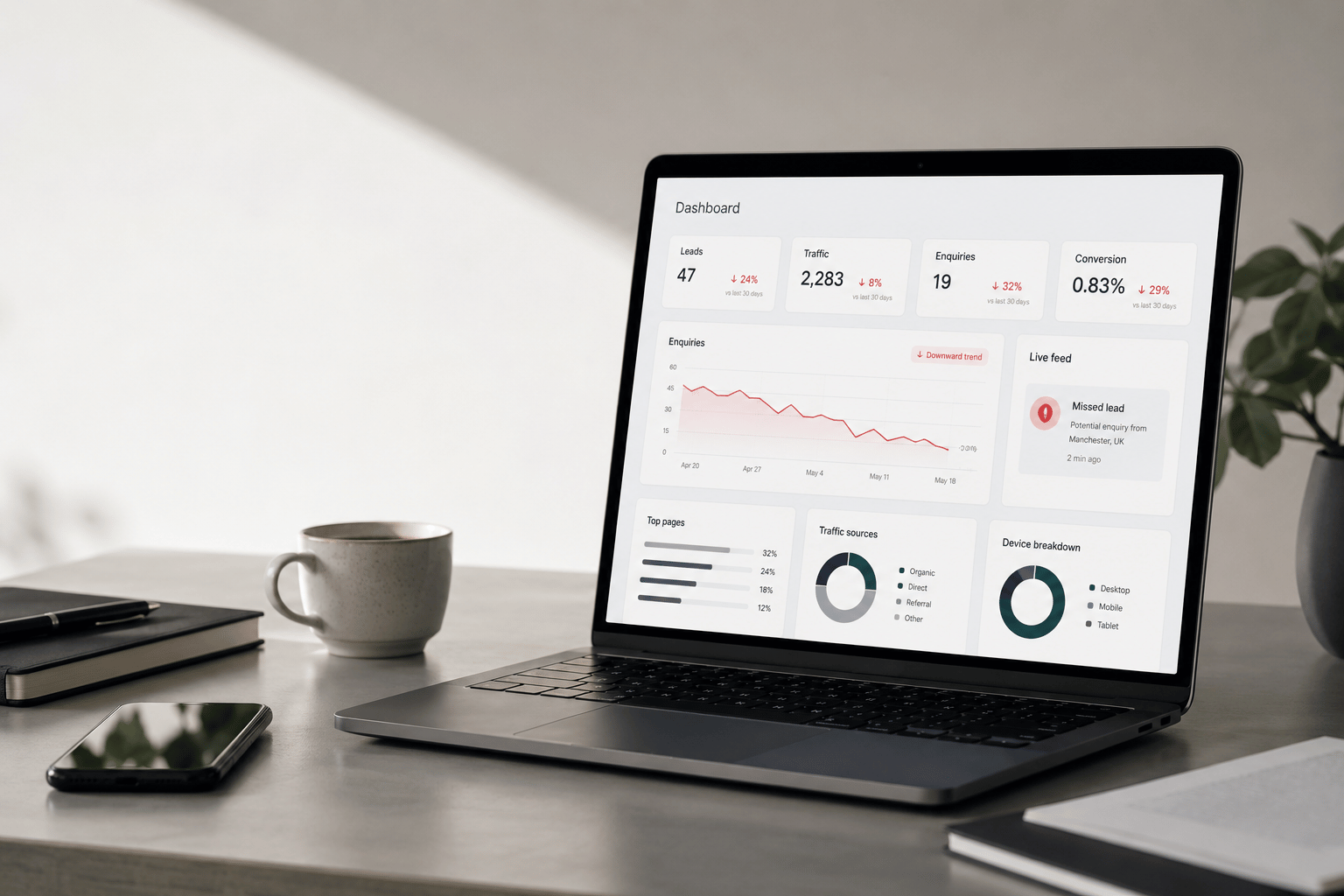
If your website gets visitors but not enough leads, something is wrong. And no, the answer isn’t always “run more ads” or “post more on social media”. Sometimes the problem is the website itself. Here are seven signs your website might be costing you leads, how how to turn a placeholder site into a dynamic growth machine – based on what we find and fix on the daily.
1. People land on your site but don’t know what you actually do
This is more common than you’d think.
A visitor lands on your homepage and sees vague lines like:
“We help businesses thrive online.”
Lovely. But what does that actually mean? Do you build websites? Sell products? Offer consultancy? Provide local services? Build apps? Fix boilers? Train dogs? Your homepage should make three things clear quickly:
Who you help.
What you do.
What the visitor should do next.
If people have to work too hard to understand your business, they’ll leave. Simple as that. Clear beats clever. Every time. Check out our home page later, it tells you that we offer Mobile App Development and Web Development from the moment you turn up.
2. Your website looks outdated compared to your actual business
Your business might be professional, reliable, and genuinely good at what it does. But if your website looks like it hasn’t been touched since 2016, customers may assume the business behind it is outdated too. That might sound harsh, but online trust is fast. People make snap decisions. Design, spacing, typography, imagery and layout all influence whether someone feels confident enough to contact you. An outdated website can make a strong business look smaller, cheaper, or less credible than it actually is.
That’s a problem if you’re trying to attract serious customers.
3. It doesn’t work properly on mobile
Most people won’t patiently pinch, zoom, scroll sideways, and fight with tiny buttons just to send you an enquiry. They’ll leave.
A mobile-friendly website is not optional anymore, if anything it’s the priority. 61% of all global internet traffic comes through a mobile device – so sites needs to appear and feel natural on smaller screens, with clear sections, readable text, easy navigation, fast loading and buttons that are easy to tap etc.
A website can look great on your laptop and still be a complete nightmare on a phone. If your customers are checking you out while they’re busy, distracted, or comparing you against competitors, that poor mobile experience can lose the lead before you even knew they existed.
4. Your pages are slow to load
Speed matters. A slow website creates friction before the visitor even sees what you offer. Large images, bloated plugins, messy code, cheap hosting, unnecessary animations and badly built themes can all drag your site down. The result?
People bounce before they read your content.
Google also cares about performance, especially when it comes to user experience. So a slow website can hurt both conversions and search visibility. A website should feel sharp, responsive and easy to move through. If it feels clunky, people notice.
5. Your call-to-action is weak or buried
A visitor should never have to wonder what to do next. If your website has vague buttons like “Learn More” everywhere, or the contact button is hidden in the footer, you’re making the visitor do too much work.
Good calls-to-action are clear and intentional.
Examples:
“Get a project quote”
“Book a discovery call”
“Start your website project”
“See website pricing”
Your CTA should guide people, not politely whisper from the corner. So don’t be shy and guide them specifically.
If your website doesn’t confidently move users toward enquiry, it’s not doing its job properly.
6. Your content talks about you, not the customer’s problem
A lot of business websites make this mistake.
They spend too much time saying things like:
“We are passionate.”
“We are innovative.”
“We pride ourselves on quality.”
“We offer bespoke solutions.”
Cool story. So what can you do for me? Your traffic is usually wondering:
Can you solve my problem?
Can I trust you?
How much will this cost?
What happens next?
Why should I choose you?
Your website copy needs to answer those questions clearly. Good content doesn’t just describe your business. It helps the customer feel understood, informed and ready to take action.
7. Your website has no clear structure for SEO or conversions
A good website is not just a collection of nice-looking pages. It needs structure and carefully considered layout and architecture.
That means clear service pages, sensible headings, strong internal links, useful blog content, local SEO pages where relevant, and a proper journey from “I found you” to “I trust you enough to enquire”.
For example, a strong website might guide users from:
Blog article → Web Development page → Pricing page → Contact page
That journey matters. It helps users understand your offer, and it helps search engines understand what your website is about.
If your website has random pages, weak headings, thin content and no proper internal linking, you’re making life harder for both Google and your customers. You’re a store that people can’t find. And when they do, there’s no obvious way in. Not good.
So, is it time to fix your website?
Your website doesn’t need to be flashy. It needs to be clear, fast, trustworthy, mobile-friendly and built around the way real customers make decisions.
If it looks outdated, loads slowly, hides the next step, or fails to explain why someone should choose you, it could be costing you leads every week. And the worst part is up until reading this article, maybe you never realised.
A properly built business website should support growth, not quietly hold it back. At Develoroo, we build custom websites for UK businesses that want more than a digital placeholder. Clear structure. Strong design. No template nonsense or too good to be true pricebait.
Just solid websites built properly — with purpose.
Ready to build a website that actually pulls its weight?
Explore our Web Development services Ecommerce Development services pages or Contact Us to start your project.